Let's say you roll a classic into our shop, point at it, and tell us you want it back exactly the way it left the factory. Same engine. Same radiator. Same drivetrain. Same everything.
We understand the instinct.
Maybe your dad had one. Maybe you had the poster. Maybe the smell of that interior takes you straight back to the summer you turned 17. Cars are very good at holding memories, and for a lot of us, that is exactly why we care about them in the first place.
We are not here to talk you out of that.
We are here to make sure you understand what you are buying before you commit a serious pile of money to a factory-correct, numbers-matching restoration.
Sometimes you are preserving history. Sometimes you are protecting the value of a genuinely rare car. And sometimes you are spending six figures to recreate 1967 cooling technology because nostalgia has excellent marketing.
Those are not the same project.
What "Numbers Matching" Actually Means
"Numbers matching" generally means that a car still has the major components it received at the factory, particularly its original engine and drivetrain. Depending on the make and model, authentication can involve VIN stampings, engine numbers, casting numbers, date codes, and the paint and trim information on the data plate. Hagerty offers a good breakdown of how the term developed and why collectors began caring about it.
On the right car, those numbers matter. A lot.
Rare Corvettes, certain Ferraris, historically important cars, and low-production models can lose substantial value when their original components disappear. One comparison involving two similar 1972 Porsche 911 2.4S examples found that the matching-numbers car sold for roughly 9.4 percent more than the other one. That is real money.
But notice the pattern: rare, documented, high-value cars.
For plenty of mass-produced classics, the engine that left the assembly line in the car may matter less to the market than people assume. Sports Car Market publisher Keith Martin has made the point plainly: he says that outside of certain collectible models, whether the engine was installed "at birth" may have little effect on value.
In other words, numbers matching is not automatically better. It is more important on some cars than others.
That's not sacrilege. It's math.
The Math Nobody Particularly Enjoys
Here is the uncomfortable part: spending more on a restoration doesn't automatically make the finished car worth more.
Hagerty's restoration guide asks whether restoration increases a car's value and gives a wonderfully honest answer: it can, but it probably won't. Unless the car is exceptionally rare or valuable, owners are unlikely to recover the cost of a comprehensive restoration.
A restoration is priced in hours, skill, parts, problem-solving, and the occasional discovery that someone in 1984 believed household wire nuts belonged under a dashboard. The finished car, however, is priced by demand.
The market does not reimburse perseverance.
That doesn't mean restoration is a bad decision. It means the return is often emotional rather than financial. You are buying the car you want, preserving something important, or finishing a project you've thought about for twenty years.
All perfectly fine reasons.
But if the original engine is already gone, the car is not especially rare, and your real goal is to drive it, chasing factory-correct perfection may add enormous cost without adding equal value, or equal enjoyment.
You Replaced the Knee. Why Not the Radiator?
More than 700,000 total knee replacements are performed in the United States every year, according to the American Academy of Orthopaedic Surgeons.
We would guess very few patients ask the surgeon to keep the original parts for authenticity.
When the motor in your washing machine dies, you do not scour the internet for a date-coded replacement from the same production week. You install something that works because you still need clean socks.
Yes, cars are more emotional than washing machines. We would never argue otherwise. Nobody walks into the garage at midnight just to stare lovingly at a Whirlpool.
But a classic is still a machine, and machines wear out. Cooling systems lose capacity. Wiring becomes brittle. Seals harden. Brakes that were acceptable when traffic was lighter and vehicles were slower can feel considerably less charming when the SUV in front of you panic-stops.
Originality and usability don't have to be enemies. The real question is which one matters more for this particular car and the way you intend to own it.
Your Memory Is Editing Out the Overheating
Nostalgia does excellent paint correction.
You remember the rumble, the chrome, the drive-in, and the way the steering wheel felt in your hands. You may not remember vapor lock, vague steering, marginal brakes, or sitting on the shoulder in July waiting for the temperature needle to come back down.
In one of Hagerty's Hack Mechanic columns, a reader asked about a stock-rebuilt 1960 Ford that ran hot in warm traffic even though it still had its original-style radiator. The answer wasn't especially romantic: poor cooling capacity and airflow. The recommended direction was a higher-capacity three- or four-row radiator core. Sometimes the correct repair is simply a better part.
Air conditioning tells a similar story. Only about 15 percent of 1967 Mustangs came with factory air, and Ford would not pair the option with the high-performance V-8. Those systems also used R-12 refrigerant, which was eventually phased out because of its effect on the ozone layer.
So when someone asks us for "factory-correct cold air," there is already some negotiating to do with both history and physics.
Your '67 is not necessarily overheating and blowing lukewarm air because it has become old and cranky. In most cases, it was like that in 1967, too.
The same engineering tends to produce the same results. Better results usually require better parts.
Why Restomods Keep Winning People Over
This is exactly why restomods exist.
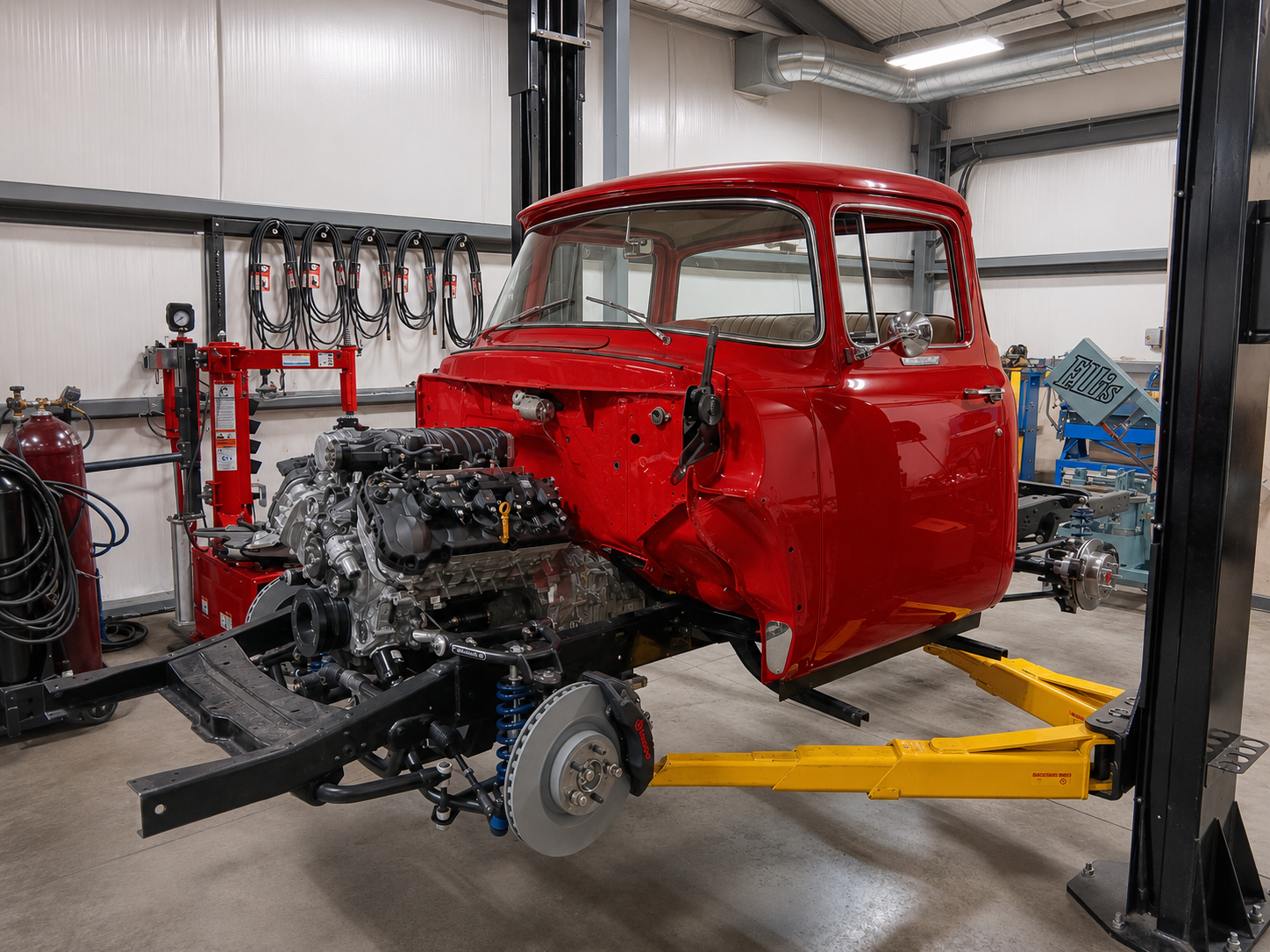
The best ones keep the sheet metal, proportions, character, and soul of the original car, then quietly correct the things that made it difficult to live with. Better brakes. Better cooling. Better steering. Fuel injection. Overdrive. Air conditioning that does more than move warm air around the cabin.
The market has noticed.
At Barrett-Jackson's Scottsdale auction, Hagerty compared stock and modified Corvettes and found several restomods outperforming their factory-correct counterparts. A modded 1958 Corvette with an Art Morrison chassis, a modern LT1, Wilwood disc brakes, and air conditioning sold for $440,000, which was twice the $220,000 paid for a factory-correct '58. A supercharged split-window restomod brought $412,500, more than a genuine Bloomington Gold-certified 1963 Z06 Competition car that sold for $330,000.
Before someone sends us an angry email, no, two auction results do not mean every restomod is more valuable than every original car.
A custom build is subjective. Trends change. Taste changes. The beautifully integrated build from a respected shop and the car covered in catalog parts by someone with an open credit card are both technically "modified." They're not the same thing.
Bad decisions are still bad decisions, even in billet aluminum.
Hagerty also correctly points out that factory-correct cars tend to age more gracefully because originality is less dependent on taste. A thoughtful restoration can remain historically relevant long after a particular wheel style or interior treatment has fallen out of favor.
But if the car is meant to be driven, modern hardware makes a very strong argument. Hemmings once described navigating modern roads on four-wheel drum brakes as "like bringing a knife to a gunfight." That may sound dramatic right up until the vehicle ahead of you stops thirty feet sooner than you can.
Nostalgia tends to leave the cabin when the brake pedal goes soft.
So, Should You Restore It to Factory Specifications?
Maybe.
If you own a rare, documented car whose originality materially affects its value, a correct restoration may be exactly the right answer. If your goal is to preserve a particular piece of history, we respect that. If you want to recreate your father's car exactly as you remember it, that's fine, too.
Just understand that you may be paying for the feeling rather than a financial return.
If your goal is a car you will actually drive, one that starts easy, stops confidently, stays cool, tracks straight, and doesn't leave you sweating through your shirt at a red light, then it's worth discussing where modern parts can improve the experience without erasing what made the car special.
Before we recommend one direction or the other, we want to know:
- How rare is the car?
- How much of it is still original?
- Is there documentation?
- Are you preserving it, showing it, driving it, or some combination of the three?
- Which upgrades can be made without cutting up anything that cannot be replaced?
- What will actually make you happy to own it five years from now?
Those questions matter more than repeating "numbers matching" until everyone in the room wants to smack you across the face.
Build the Car You Actually Want to Own
At Restoration Rods, we're not loyal to one restoration philosophy. We appreciate a beautifully correct survivor. We appreciate a carefully restored piece of history. We also appreciate a classic that fires on the first turn, holds temperature in Boise traffic, and can stop without a written request and several business days' notice.
The wrong answer is spending a fortune building a museum piece when what you really wanted was a weekend driver. The other wrong answer is modernizing a rare, intact survivor past the point where the decision can be undone.
Our job is to help you know which car you have, and which car you actually want.
Bring us the car, the story behind it, and an honest description of how you plan to use it. We will help you decide what deserves to be preserved, what would benefit from being improved, and where your money will make the biggest difference.
Because the car that gives you goosebumps should also get you from point A to point B.