Ask someone at a car show to name an American car manufacturer, and you'll probably hear Ford, Chevrolet, or Dodge. Maybe Pontiac if they're feeling nostalgic. Ask about Studebaker, though, and you'll generally get one of two reactions: a blank stare or someone who's suddenly very excited to tell you about their uncle's Hawk.
American automotive history is full of manufacturers that took chances, challenged convention, and occasionally built something Detroit's Big Three wished they'd thought of first. Some were engineering pioneers. Others were responsible for designs so unusual that we're still talking about them decades later.
Unfortunately, building a great car and building a profitable car company aren't always the same thing. Lots of remarkable manufacturers disappeared along the way, leaving behind vehicles that deserve considerably more attention than they get.
Let's give a few of them their due.
Studebaker: From Horsepower to Horsepower
1852–1966
Studebaker's story began in 1852, when brothers Henry and Clement Studebaker opened a blacksmith shop in South Bend, Indiana. They started building wagons, which they eventually supplied to the Union Army during the Civil War. By the turn of the century, Studebaker had become one of America's largest manufacturers of horse-drawn vehicles.
When automobiles started replacing horses, plenty of wagon manufacturers went out of business. Studebaker decided to change with the times, introducing its first automobile in 1902.
And here's something that might surprise you: it was electric.
Seriously. More than a century before electric vehicles became the subject of heated dinner-table conversations, Studebaker was building them. The company eventually transitioned to gasoline-powered vehicles, but you've got to appreciate the irony.
Studebaker really found its personality in the postwar years. Its 1947 Champion and Commander models looked very different from their competitors, and it set them apart dramatically. Then came the famous bullet-nose designs of 1950 and 1951, complete with a chrome centerpiece that looked suspiciously like it belonged on a plane.
The Starlight coupe's wraparound rear window was another interesting choice. People joked that you couldn't tell whether the car was coming or going. We can see their point.
But Studebaker wasn't finished experimenting. In 1962, it introduced the Avanti, a fiberglass-bodied performance car with distinctive styling, front disc brakes, and available supercharged V8 power. Under Andy Granatelli's direction, Studebaker took supercharged Avantis to Bonneville and set numerous speed records.
The Avanti was ambitious, unconventional, and genuinely impressive. Unfortunately, it wasn't enough to save Studebaker.
The company closed its South Bend automobile plant in December 1963 and continued production in Canada until March 1966. The Avanti, however, proved harder to kill. Various independent manufacturers kept versions of it alive for decades.
Apparently, nobody told the car its manufacturer had gone out of business.
Source: Studebaker National Museum
Hudson: The Six-Cylinder That Embarrassed Everyone
1909–1957
If you've ever watched Pixar's Cars, you're already familiar with the Hudson Hornet, even if you didn't realize it.
Doc Hudson wasn't just a fictional character with a colorful past. He was inspired by a car that absolutely dominated American stock car racing in the early 1950s.
Hudson introduced its innovative step-down design in 1948. Instead of placing the passenger compartment entirely above the frame, engineers lowered the floor between the frame rails. This gave the car a lower center of gravity and handling characteristics that were atypically good for a big American sedan.
Then Hudson introduced the Hornet, powered by a 308-cubic-inch straight-six engine. With its available Twin H-Power induction system, the Hornet became a formidable competitor on the racetrack.
In 1952, Hudson drivers won 27 of NASCAR's 34 Grand National races. Think about that for a sec. While other manufacturers were busy promoting their V8s, Hudson was winning races with just a straight-six and some clever engineering.
Unfortunately, racing success didn't guarantee financial success. Hudson merged with Nash in 1954 to create American Motors Corporation, and the Hudson name disappeared after the 1957 model year.
The Hornet remains a wonderful reminder that horsepower isn't everything. Sometimes the smartest engineering wins.
Packard: Ask the Man Who Owns One
1899–1958
Long before luxury buyers were debating Mercedes versus Cadillac, Packard was building some of America's most prestigious automobiles.
Its famous advertising slogan, "Ask the man who owns one," first appeared in 1902. We have to give its marketing department credit. That's an extraordinary amount of confidence packed into six words.
And Packard had reason to be confident.
Its vehicles were beautifully engineered, meticulously constructed, and frequently owned by people who could afford just about anything they wanted. Packard became synonymous with American automotive luxury, competing with manufacturers like Cadillac and Pierce-Arrow.
But the automotive industry changed significantly after World War II. Independent manufacturers struggled to compete with the production capacity and resources of Detroit's largest companies.
In 1954, Packard merged with Studebaker. The hope was that combining two established manufacturers would give both companies a fighting chance.
Unfortunately, two struggling companies don't automatically make one healthy company.
By the final years of production, Packard-branded vehicles were essentially modified Studebakers. Enthusiasts weren't particularly impressed and nicknamed them "Packardbakers."
The last Packard rolled off the assembly line in 1958, ending one of America's most distinguished automotive names.
At least the slogan survived. More than a century later, it's still a pretty good lesson in marketing.
Source: Detroit Historical Society
Pierce-Arrow: From Birdcages to Presidential Garages
1901–1938
Some automotive companies have unusual beginnings. Pierce-Arrow might have one of our favorites.
Founder George N. Pierce started out manufacturing household products, including birdcages and iceboxes, before moving into bicycles and eventually automobiles.
It's quite a career progression.
By the early 20th century, Pierce-Arrow had become one of America's premier luxury manufacturers. Its vehicles were expensive, beautifully constructed, and favored by wealthy buyers and even American presidents.
The company's most recognizable feature arrived in 1913, when Pierce-Arrow introduced headlights integrated into the front fenders. While competitors mounted their headlights separately, Pierce-Arrow incorporated them directly into the bodywork.
The result was a distinctive appearance that made its cars recognizable from practically any angle.
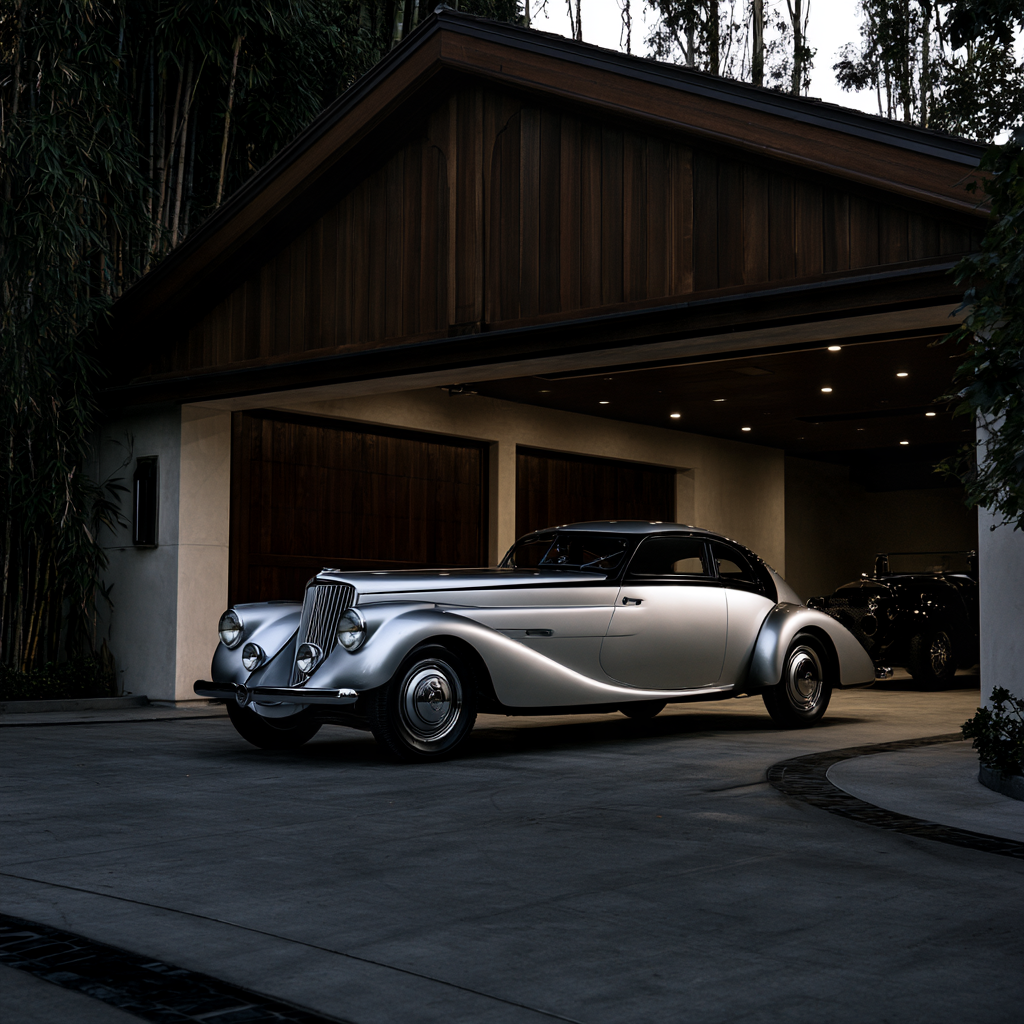
Studebaker purchased Pierce-Arrow in 1928, hoping to expand into the luxury market. The partnership produced one of the most spectacular automobiles of the era: the 1933 Silver Arrow.
With its dramatically streamlined body, sweeping lines, and futuristic styling, the Silver Arrow looked like something from another decade. Only five examples were built, with an original price of approximately $10,000 each.
For perspective, that was an extraordinary amount of money during the Great Depression. Unfortunately, beautiful engineering and spectacular styling weren't enough to overcome the economic realities of the era.
Pierce-Arrow ceased operations in 1938.
If you ever get the opportunity to see a Silver Arrow in person, take it. Photographs don't quite do that car justice.
Source: Studebaker National Museum
Cord: Because Normal Headlights Were Too Boring
1929–1937
When Cord introduced the 810 in 1935 for the 1936 model year, it looked like practically nothing else on the road.
Designed by Gordon Buehrig, the Cord 810 featured front-wheel drive, independent front suspension, distinctive coffin-nose styling, and concealed headlights. Those headlights were operated manually using cranks inside the cabin.
Imagine explaining to someone that your car has hidden headlights, but you have to crank them open yourself.
It's wonderfully ridiculous, and we love it.
The Cord 810 and subsequent 812 were remarkably advanced for their time. Unfortunately, production problems, mechanical issues, and financial difficulties prevented the cars from achieving lasting commercial success.
Cord automobile production ended in 1937.
Decades later, concealed and pop-up headlights became popular on everything from Corvettes to Ferraris and Mazda Miatas. Cord had already explored the concept when most American cars still had headlights perched on either side of their grilles.
Being ahead of your time is impressive. Convincing customers to buy what you've invented is apparently another matter.
Tucker: Fifty-One Cars and One Extraordinary Story
1947–1949
Few American automotive stories have inspired as much fascination as Preston Tucker's attempt to build a revolutionary postwar car.
The Tucker 48 was unlike most American cars of its era. It featured a rear-mounted engine, innovative safety concepts, and a distinctive third headlight positioned in the center of the front end.
That center light, nicknamed the Cyclops Eye, turned with the steering to help illuminate corners.
Tucker had ambitious plans for the automobile, but the company encountered financial problems, production challenges, and an investigation by the Securities and Exchange Commission.
The resulting fraud trial ended with Tucker and his associates being acquitted, but by then the company was finished.
Only 51 Tucker automobiles were completed, including the prototype.
Today, surviving Tuckers are extraordinarily valuable collector cars. One sold for nearly $3 million in 2012, which isn't bad for a manufacturer that barely got started.
The Tucker story is complicated, and historians continue to debate various aspects of the company's downfall. What's beyond dispute is that the surviving cars represent one of the most fascinating chapters in American automotive history.
Kaiser Darrin: The Doors Went Where?
1954
Every once in a while, a designer comes up with something that makes you wonder whether everyone else in the room was too polite to ask questions.
The Kaiser Darrin's doors are a perfect example.
Introduced for the 1954 model year, the Darrin was a two-seat fiberglass sports car with doors that slid forward into pockets inside the front fenders.
Not outward. Not upward. Straight into the fenders.
Designed by Howard "Dutch" Darrin, the car was strikingly attractive and genuinely unusual. It also came from an automotive company associated with industrialist Henry J. Kaiser, whose broader business interests eventually included the organization that became Kaiser Permanente.
Unfortunately, the Darrin arrived at a difficult time for Kaiser Motors. Only 435 production examples were built, and the model disappeared after a single year.
If you happen to encounter one at a car show, take a good look at the doors. They're an excellent reminder that automotive designers once had considerably more freedom to experiment with ideas that might never make it past a modern corporate committee.
Source: Kaiser Permanente History
Nash Metropolitan: Small Car, Big Personality
1953–1961 production
Not every forgotten automotive brand was chasing speed records, luxury buyers, or revolutionary engineering.
Sometimes the goal was just to build something small, affordable, and practical.
The Nash Metropolitan was designed specifically for American buyers but manufactured in England by Austin. Production started in 1953, and the car arrived in American showrooms in 1954.
With its tiny proportions, cheerful styling, and economical four-cylinder engine, the Metropolitan was dramatically different from the enormous American automobiles that dominated the era.
It wasn't particularly fast, and nobody was buying one to intimidate the competition at a stoplight.
The Metropolitan offered an alternative to the prevailing American philosophy that bigger was always better. And judging by the attention these little cars still attract at shows, its personality has aged remarkably well.
We'd argue that it's nearly impossible to look at a Metropolitan without smiling.
Why We Still Care About These Cars
It's easy to look back at automotive history and focus on the companies that survived. Ford, Chevrolet, Dodge, and the other familiar names certainly earned their places in the history books.
But the companies that disappeared deserve some attention, too.
Studebaker experimented with electric vehicles more than a century ago. Hudson demonstrated what intelligent chassis engineering could accomplish on a racetrack. Packard established an extraordinary reputation for American luxury, while Pierce-Arrow produced some of the most beautiful automobiles ever built.
Cord challenged conventional automotive design, Tucker pursued ambitious engineering ideas, and Kaiser somehow convinced everyone that doors disappearing into the fenders were perfectly reasonable.
And the Nash Metropolitan? Well, sometimes a car doesn't need to do anything revolutionary. Sometimes it just needs to make people happy.
These manufacturers remind us that automotive innovation doesn't always come from the biggest companies or the brands with the deepest pockets. Sometimes it comes from smaller manufacturers willing to take a chance on an idea nobody else was pursuing.
Unfortunately, keeping their cars on the road today can be a challenge. Replacement parts aren't always readily available, documentation can be scarce, and finding someone who's comfortable working on a 70-year-old straight-eight isn't quite as simple as scheduling an oil change.
Fortunately, we happen to enjoy that sort of thing.
At Restoration Rods, we appreciate the cars that don't necessarily attract a crowd because everyone recognizes them. Sometimes the most interesting vehicle in the shop is the one that makes someone stop, scratch their head, and ask what on earth they're looking at.
If you've got an old Studebaker, Hudson, Packard, or another piece of American automotive history tucked away in your garage, we'd love to see it. Whether you're interested in restoration, mechanical repairs, or just getting back on the road, those are exactly the kinds of projects that keep this business interesting.
And if you're a fan of Hudsons, Nashes, or Ramblers, you might also enjoy connecting with the local Treasure Valley AMC Club.
After all, somebody has to keep these cars and their stories alive. We think they're worth the trouble.