
Shop Talk
You Won't Get in Trouble If You Can Keep Your Foot Out of It
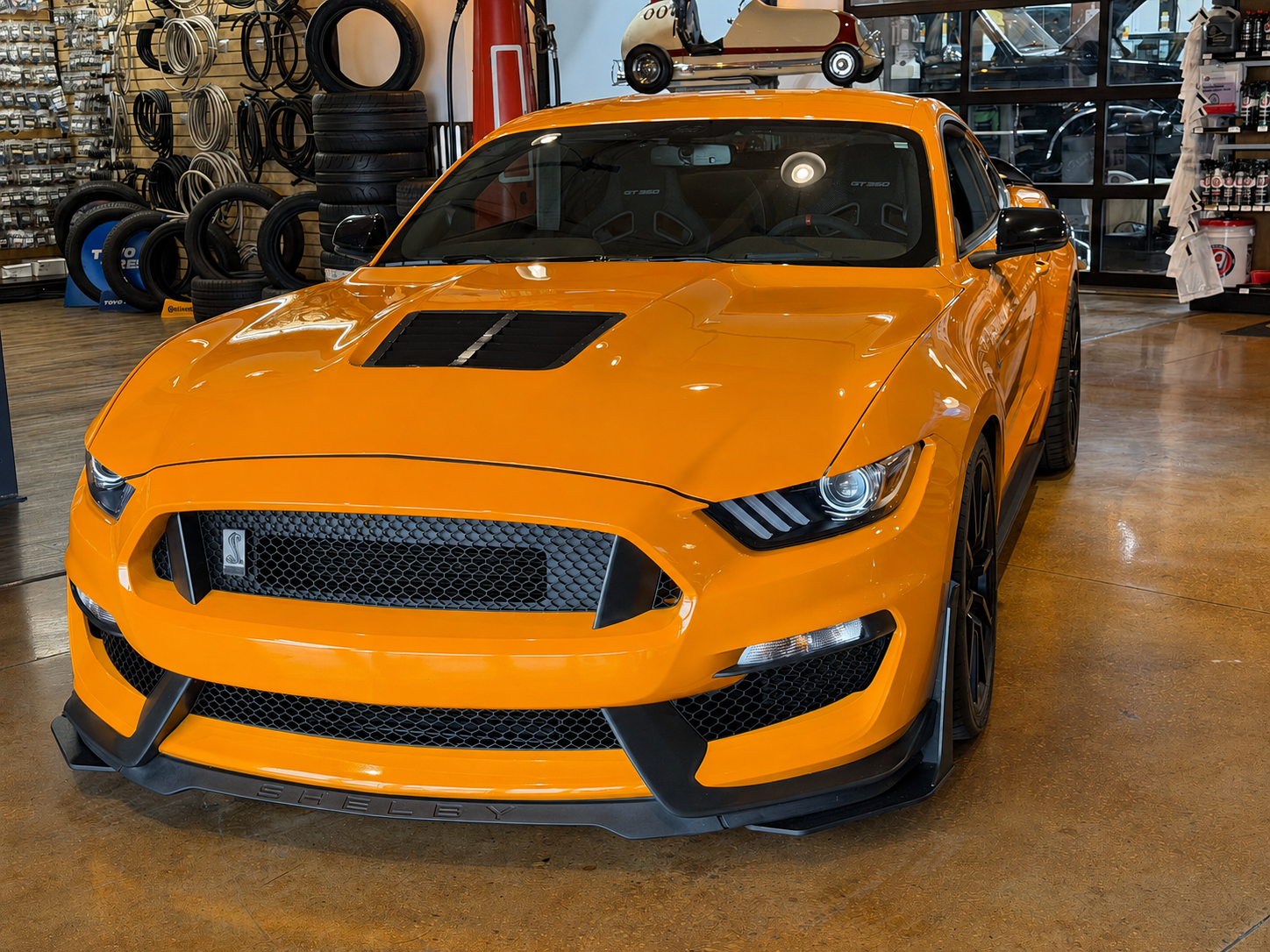
A guy took one of our cars out this weekend. He came back the way people come back from that particular kind of test drive: a little quieter than when he left and grinning about something he didn't need to explain.
Then he said this:
"You won't get in trouble in it, as long as you can keep your foot out of it."
That is a beautiful sentence, mostly because it contains its own confession.
He wasn't saying the car was dangerous. He was saying he wasn't entirely sure he could be trusted with it.
Neither are we. Neither is anybody who has ever put a right foot on a pedal connected to real power.
Speed sells cars. It always has. Not because most of us have anywhere to be at 160 mph, and not because the grocery store has started awarding trophies for fastest arrival. Speed sells cars because it creates a feeling, and feelings have talked people into far more expensive decisions than engines ever have.
Your Brain is not Especially Helpful Here
Researchers in Japan once put 34 everyday drivers into an fMRI scanner and showed them driver's-eye video of a car moving down a rural road at different speeds. Nobody was driving. Nobody was at risk. Nobody was even going anywhere.
As the speed on the screen climbed, activity in the brain's reward system climbed with it. The response was stronger among the people who already liked sports cars (Scientific Reports).
That is a very polite scientific way of saying some of us come pre-loaded. The brain responded to the appearance of speed through a windshield that wasn't real, inside a machine that wasn't moving. Put the same person behind the wheel and the rest of the body joins the meeting. Heart rate goes up. Hands tighten. Attention narrows. The car settles back on its rear tires and, for a few seconds, every unfinished email and home repair disappears from memory.
This is not the practical side of car ownership. It is the reason the practical side keeps losing arguments.
People can talk about investment value, production numbers, engineering, history and provenance, and all of those things matter. But a lot of performance-car purchases come down to something much simpler:
That car made me feel something, and I wanted to feel it again.
We Have Been Chasing the Number Since 1898
The first officially recognized land-speed record was set in 1898 at 39.24 mph (Euronews). At the time, that was astonishing.
Then somebody wrote the number down, which was all the encouragement the rest of humanity needed. The record has been beaten steadily since then.
Malcolm Campbell broke the record nine times between 1924 and 1935. In 1933, he reached 272 mph at Daytona, which was about 20 mph faster than he had gone the year before. His son Donald later took a Bluebird to 403 mph. In 1997, Andy Green reached 763.035 mph and broke the sound barrier on land.
Notice what is missing from that entire century of effort?
No cargo. No destination. Nobody was late for anything.
The whole point of the trip was the number.
Speed has its own purpose.
That impulse did not arrive with the automobile. The automobile just gave it better equipment.
Zero to Sixty: the Number Nobody Needs and Everybody Knows
We all know what zero to 60 means. We quote it about cars we own, cars we want, and cars we will never own. People who cannot remember an anniversary can recall a launch time to the tenth.
What's weird is it's not even a particularly tidy measurement. Tires matter. Pavement matters. Temperature, gearing, launch control and driver technique all matter. Most drivers will never perform a full-throttle launch on a public road, which is probably best for the continued health of their driveline and insurance premium.
Still, the number works because everybody understands what it is trying to describe: How hard does this thing go?
Top speed is impressive, but, it's also often theoretical. Acceleration is personal. It's the part you feel through the seat. It's the instant a car stops being an object you admire and becomes something happening to you.
And this is where people new to performance cars can get understandably lost, because the conversation usually makes a sudden jump. We start by talking about how fast a car feels, then somebody throws out "800 horsepower" as if horsepower and speed were the same thing.
They aren't.
Speed is the result. Horsepower is part of how you get there.
Speed is how fast the car is traveling. Acceleration is how quickly that speed changes. Horsepower describes the rate at which the engine can do work.
Those three are related, but you cannot swap one for another.
If you are new to this world, here is the useful version. Torque is twisting force, it's the shove. Horsepower tells us how quickly the engine can keep delivering work as rpm rises. Weight, gearing, traction and aerodynamics then decide what the entire car can do with it.
That's why two cars with the same horsepower can feel nothing alike. A lighter car might leap forward while a heavier one gathers itself first. One car hooks and goes; another turns its first 100 feet into smoke and optimism. One has gearing that keeps the engine exactly where it is happiest. The other has a beautiful peak number it visits about as often as most people visit the dentist.
Horsepower doesn't tell the whole story. Though, it does tell an important part of it.
The next question is whether the number is real.
"Should make" is a horoscope
Read enough performance-car ads and you start to recognize the grammar:
Should make around 650.
Built to make 700-plus.
The combination is good for about 800.
Maybe it is.
Those numbers are usually educated guesses assembled from a parts list, advertised component ratings, boost, fuel, previous builds and optimism. Every part in the engine arrived with a promising number attached. Engines are under no legal obligation to add them up correctly.
There's one honest way to find out. It involves a very heavy machine and a very loud afternoon.
What the dyno has to do with speed
A chassis dynamometer doesn't tell us how fast a car can cross Idaho. It tells us how much power reaches the drive wheels and what the engine is doing while it gets there.
The drive wheels sit on rollers. The car is strapped down. Fans move air across it. The dyno applies a controlled load while the car runs through the rpm range, measuring torque at the rollers and calculating horsepower from torque and engine speed.
The speedometer may be climbing, but the car is not traveling down the road. That is the point.
We can put the engine and drivetrain under real load, watch what happens and repeat the test after an adjustment; all without traffic, intersections, oncoming cars or an Idaho State Police officer becoming part of the data-collection process.
So the connection is not that horsepower is speed. It is that horsepower helps create the acceleration people feel, and the dyno gives us a controlled way to measure and refine that power.
Speed is the passion. The dyno is where we replace the story with evidence.
Eight hundred horsepower…measured where?
Once somebody gives you a horsepower number, this should be your next question.
An engine dyno measures power directly at the engine's crankshaft, before it passes through the transmission, driveshaft, differential, axles and tires. This is generally the kind of horsepower figure a manufacturer advertises.
A chassis dyno measures the power that survives that entire trip and reaches the drive wheels. That is wheel horsepower.
Some power is consumed along the way by friction, heat and the work of turning all those parts. The exact difference varies by transmission, drivetrain, tires, test conditions and the dyno itself. There is no single magic drivetrain-loss percentage that makes every internet argument go away. We have checked.
But wheel horsepower will normally be lower than crank horsepower. A car rated at 300 horsepower at the crank might put roughly 255 to the wheels.
That doesn't mean 45 horses escaped somewhere near the differential. It means the two figures were measured at different places.
It also means 800 horsepower at the crank and 800 horsepower at the wheels are two very different claims. Eight hundred at the wheels requires substantially more power at the engine because the drivetrain has already taken its share before the number is recorded.
Same three digits. Two entirely different cars, and usually two entirely different price tags.
If a seller becomes vague right when you ask "measured where," he may have answered the question.
The peak number gets the headline. The curve builds the car.
Peak horsepower is easy to sell. It is one large number at one point in the rpm range, and it fits nicely in an ad.
What you actually feel is the whole curve.
You feel how early the torque arrives, whether it stays, how cleanly the engine pulls through the middle and whether it keeps building or runs out of breath. A car with a broad, usable curve can feel faster, and be far more fun, than a car with a heroic peak number and not much living underneath it.
That's why the person running the dyno is watching more than the upper-right corner of the graph.
Air-fuel ratio matters. Ignition timing matters. Fuel delivery, boost behavior and temperature matter. An engine does not have to fail at peak power. It can fail in one narrow window where the mixture went lean, the timing got aggressive and nobody was looking.
Dyno tuning gives us a controlled place to find that window, make a correction and pull again.
The alternative is discovering the same problem on the road at full throttle, in traffic, with your own money inside the engine. That version tends to come with a tow bill and a machine-shop estimate.
We would rather find it in the back bay on a Tuesday, with the hood up and coffee nearby.
The part we are not going to be cute about
Speed and consequence ride together. We sell fast cars, but we are not going to pretend a public road is a dyno bay.
A large analysis of driving research found that sensation seeking was consistently associated with risky driving, aggressive driving, tickets and crashes (Accident Analysis & Prevention). The same part of a person that wants to feel the car pull can also make the right foot a little ambitious.
In Idaho, speeding fines start at $90 for 1 to 15 mph over and $155 for 16 mph or more over under the current statewide penalty schedule (Idaho Supreme Court). Frankly, a ticket is the cheapest bad outcome available.
Our customers' cars are irreplaceable. So are our customers.
The car is not the variable. You are.
There is an 800-wheel-horsepower Shelby Mustang in our showroom
Our 2018 Shelby GT350 makes 800 horsepower at the wheels.
Not "should make." Not "the parts are good for." Measured at the wheels.
Its 5.2-liter Voodoo was rebuilt, balanced and assembled to competition specifications, then topped with a Whipple supercharger. The build includes ARP head studs, GT500 head gaskets, Ford Performance springs, Steeda rear suspension components, upgraded bushings and triangulated braces.
It has been fed Red Line, kept in a garage and cared for well enough that the interior suggests its previous owner possessed an almost supernatural level of restraint.
It has a license plate. It will go to the grocery store. It will also permanently rearrange your understanding of what a Mustang is.
The paperwork behind that number exists. We do not post complete dyno files online for spectators to argue over, and we do not hand the build records across the counter to everybody who wanders in to look.
If you are seriously considering the car, we will sit down with you, put the file in front of you and answer every uncomfortable question you have—in the same room as the people who did the work.
Until then, come see it.
We'll hand you the keys, and then we'll give you the same advice our guy gave us this weekend:
You won't get in trouble if you can keep your foot out of it.